Hashima Island: A Digital Source Investigation
14 curated digital sources for classroom use
For teachers: This sheet provides 14 digital sources about Hashima Island (also known as Gunkanjima or "Battleship Island"), a former coal mining site off the coast of Nagasaki, Japan. The sources tell different stories about the same place. Students can examine them to develop skills in source analysis, interpretation, and understanding how digital content shapes historical knowledge.
How to use this sheet: Each source includes a URL, a brief description of what students will find there, and a guiding question. Sources are lettered A–N for easy reference. They can be used individually, in selected groups, or as a complete set. The teacher notes at the end suggest six different groupings for comparison exercises.
A note on language: These sources use different terms for the same historical events. Some describe workers "brought against their will and forced to work" (UNESCO's language). Others refer to "requisitioned" labour, "forced labourers," or do not mention the workforce at all. These differences are not accidental — they are part of what students are analysing.
A note on language access
Several of these sources were originally published in Japanese or Korean. Where a source is not in English, we have provided a translated summary of the key content so you can analyse it in class without needing to read the original language.
But notice what this means: the most important conversations about Hashima Island's history are happening in languages most British students don't speak. The people making decisions about how this site is remembered — government officials, heritage managers, tour operators — are primarily writing for Japanese and Korean audiences, not for you. The English-language versions of these sources are translations, summaries, or simplified versions of content that exists in much greater detail in the original languages.
This is itself a form of gatekeeping. If you can't read the source in its original language, you are relying on someone else's choices about what to translate and how to translate it. Learning to read these sources in the original is one of many reasons to study an East Asian language at university.
Interested in learning Japanese, Korean, or Chinese? SOAS University of London offers degree programmes in Japanese, Korean, and Chinese — including combined degrees with History. Many other UK universities offer East Asian language programmes too. Search UCAS for options closer to home.
Need a printable version? Download source packs with key excerpts included — no internet required in the classroom.
KS3 Source Pack: Sources B, C, D, I, L (PDF)
GCSE Source Pack: Sources A, E, F, G, K, N (PDF)
If a link is broken: These sources link to live external websites that may be restructured over time. If a URL no longer works, the key analytical content from each source is preserved in the downloadable source packs above. You can also try searching for the page title on the Wayback Machine (web.archive.org), which archives snapshots of web pages. Broken links are themselves evidence of how digital sources can disappear — a point worth making to students.
Source A
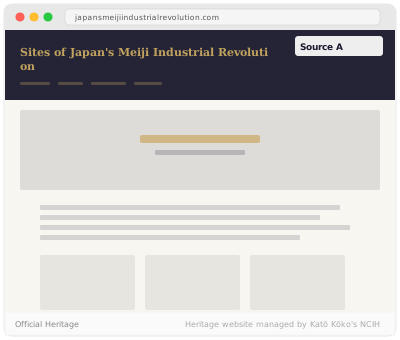
"Hashima Coal Mine" — Sites of Japan's Meiji Industrial Revolution (official heritage website)
https://www.japansmeijiindustrialrevolution.com/en/site/nagasaki/component04.html
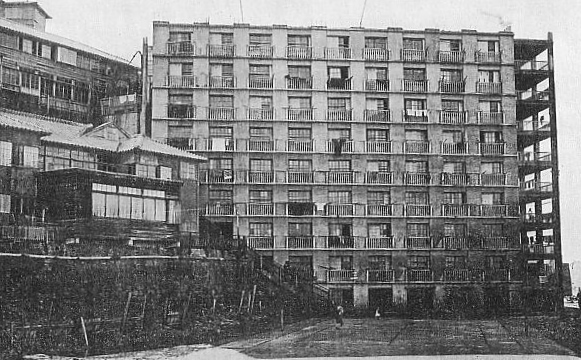
This page describes Hashima as a component of the UNESCO World Heritage property "Sites of Japan's Meiji Industrial Revolution." It is part of an official heritage website managed by the World Heritage Council for the Sites of Japan's Meiji Industrial Revolution. The site footer reads: "Directed by Koko Kato." Katō Kōko is a Japanese politician and businesswoman whose government-funded organisation, the National Congress of Industrial Heritage, also manages the Industrial Heritage Information Centre in Tokyo. The page presents the island's history as a story of industrial achievement: undersea coal mining pioneered by Mitsubishi, technological innovation, and extraordinary community life. It includes a photo gallery.
Guiding question: Read the entire page carefully. What aspects of Hashima's history does this source describe? What aspects does it not mention? Why might those choices matter for a heritage website?
Key content in English (this source has an English version)
The English version of this page describes Hashima as a site where "Japan's first large-scale undersea coal extraction was carried out" and celebrates the "technological innovation" of the mining operation. It includes a photo gallery of the island but makes no reference to wartime forced labour. The page footer reads: "Directed by Koko Kato."
Note: The Japanese-language version of this site contains substantially more content than the English version. What is included or excluded from a translation is itself a form of editorial choice.
Source B
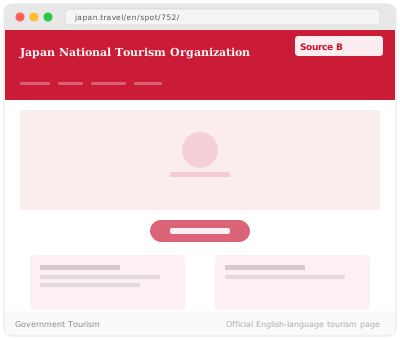
"Hashima (Gunkanjima)" — Japan National Tourism Organization
https://www.japan.travel/en/spot/752/
This is the official English-language tourism page for Hashima, published by the Japan National Tourism Organization (JNTO), a government body that promotes international tourism to Japan. It describes Hashima as "one of Japan's most unlikely tourist attractions" and focuses on the boat tour experience, the island's "eerie" ruins, and practical visitor information. The page was written for international tourists considering a visit.
Guiding question: How does this source describe Hashima? What words and images does it use to make the island appealing to visitors? Does it mention the same historical events as Source A — or different ones?
Source C
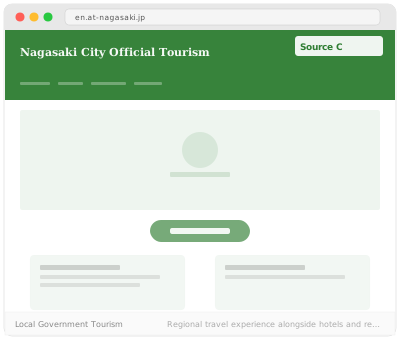
"Hashima Coal Mine" page — Nagasaki City Official Tourism Site
https://en.at-nagasaki.jp/feature/sekaiisan-botsunew
Nagasaki City's tourism site presents Hashima as part of a regional travel experience alongside hotels, restaurants, and scenic viewpoints. The page describes the island's World Heritage status and invites visitors to "experience the history that continues today." It includes information about local tour operators departing from the nearby port of Nomozaki and recommendations for nearby attractions.
Guiding question: This source places Hashima alongside cafés, hotels, and beach visits. What effect does this context have on how a reader understands the island? What kind of "history" is the reader being invited to experience?
Source D
"Gunkanjima (Battleship Island)" — GaijinPot Travel
https://travel.gaijinpot.com/gunkanjima/
GaijinPot is a popular English-language website for foreigners living in and visiting Japan. This travel guide describes Hashima as "the inspiration behind the villain's hideout in the 2012 Bond film Skyfall" and provides practical tour information. It acknowledges the forced labour history in one paragraph, noting that Mitsubishi used "Koreans and Chinese for hard labor" during World War II. It then adds: "Tour guides are normally reluctant to address this issue so it's best not to push it."
Guiding question: This source acknowledges the forced labour history but advises visitors not to ask about it. What does this advice tell us about how the island is interpreted for visitors today? Who benefits from this kind of silence?
Source E
Decision 39 COM 8B.14 — UNESCO World Heritage Committee (2015)
https://whc.unesco.org/en/decisions/6364/
This is the official UNESCO decision that inscribed Hashima (as part of the "Sites of Japan's Meiji Industrial Revolution") on the World Heritage List in July 2015. It is a formal international document written in diplomatic language. The decision describes the property's "Outstanding Universal Value" — Japan's rapid industrialisation as "the first non-Western country to successfully industrialize." The decision also includes requirements that Japan agreed to, including developing "an interpretive strategy for the presentation of the property" that "allows an understanding of the full history of each site."
Guiding question: What does this decision celebrate about the Meiji industrial sites? What does the phrase "full history of each site" imply might be missing from the way the sites are currently presented?
Source F
State of Conservation Report and Decision 44 COM 7B.30 — UNESCO World Heritage Committee (2021)
https://whc.unesco.org/en/soc/4085/
Six years after Source E, UNESCO sent a mission to inspect the Industrial Heritage Information Centre (IHIC) that Japan had opened in Tokyo in 2020 to fulfil its commitment to tell the "full history." This page contains both the mission's findings and the Committee's decision. The mission concluded that the IHIC's interpretation was "currently insufficient" in allowing understanding of those "brought against their will and forced to work." It noted that the testimonies displayed at the centre "convey the message that there were no instances of [Koreans and others] being forced to work." The Committee's decision states that it "strongly regrets" that Japan "has not yet fully implemented the relevant decisions."
Guiding question: Compare the language in this source to Source E. What changed between 2015 and 2021? What does the phrase "strongly regrets" mean in diplomatic language, and what power does UNESCO actually have to enforce its decisions?
Source G
"Japan's 'Island of Hell' whitewash mars UNESCO Heritage site" — Korea.net (2020)
https://www.korea.net/NewsFocus/Society/view?articleId=186700
Korea.net is the official English-language website of the Republic of Korea (South Korea). This article was published shortly after the Industrial Heritage Information Centre opened in Tokyo in June 2020. It describes the centre's displays as "disinformation" and calls Hashima an "island of hell," reporting that Korean survivors described a neighbouring island as "the crematory." The article states that between 500 and 800 Koreans worked as forced labourers at Hashima during the Pacific War, and that 122 Koreans are confirmed to have died there.
Guiding question: This source uses very different language from Sources A–D. What words and phrases reveal its perspective? Is it possible for this source and Source A to both be accurate? What would a historian need to do to evaluate the claims made here?
Source H
"Hashima Island" — Wikipedia
https://en.wikipedia.org/wiki/Hashima_Island
Wikipedia's article on Hashima Island attempts to cover the island's full history, including its industrial development, daily life, forced labour, UNESCO inscription, and the IHIC controversy. It includes claims and counter-claims from multiple parties, each with citations. The article notes that Japan's UNESCO representative acknowledged in 2015 that people were "brought against their will and forced to work under harsh conditions," while immediately afterwards the Japanese Foreign Minister "rejected the idea that Koreans were 'forced labourers'" and claimed they were "requisitioned against their will."
Guiding question: Wikipedia tries to present multiple perspectives on Hashima. How does it structure disagreements between different sources? Does presenting "both sides" of a contested history produce balance — or does it create a false equivalence? What can this article do that the other sources cannot?
Source I
"Gunkanjima Landing & Cruise" — Yamasa Shipping (tour operator)
https://www.gunkan-jima.net/en/
This is the official English-language website of one of the companies licensed to operate boat tours to Hashima. The page provides safety information, booking procedures, and visitor rules. Photography is "freely" permitted on the island but recording on-board announcements is "prohibited." Visitors can only access a small southern section of the island; the residential areas are off-limits. Tours are cancelled roughly two-thirds of the year due to weather.
Guiding question: What does this source tell us about how visitors physically experience Hashima? What can they see, and what can't they see? How does controlling physical access to a site shape what people understand about its history?
Key content in English (this source has a limited English version)
The English-language pages describe the tour as a "cruise around Gunkanjima" and provide practical booking information. Visitors can only access a small southern section of the island; the residential areas and former mine entrance are off-limits. The site notes that photography is "freely" permitted on the island but recording on-board announcements is "prohibited." Tours are cancelled roughly two-thirds of the year due to weather conditions.
Note: The Japanese-language site contains a fuller description of the tour route, historical background, and safety information that is not available in English.
Source J
"Hashima Coal Mine" — UNESCO World Heritage List (official listing page)
https://whc.unesco.org/en/list/1484
This is the formal UNESCO listing page for the entire "Sites of Japan's Meiji Industrial Revolution" property. It includes the official description, the Statement of Outstanding Universal Value, maps, and links to all State of Conservation reports and Committee decisions since inscription. The listing page presents the property as internationally significant under criteria (ii) and (iv): an "exceptional interchange of industrial ideas" and testimony to "Japan's unique achievement in world history."
Guiding question: UNESCO is an international body that is meant to act in the interest of all nations. Compare how this listing describes the sites to how Source A describes them and how Source G describes them. Whose version of Hashima's history has the most authority — and who decided that?
Source K
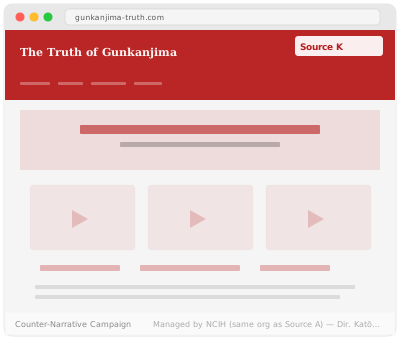
"The Truth of Gunkanjima" — National Congress of Industrial Heritage (NCIH)
https://www.gunkanjima-truth.com/l/en-US/
This website was launched in 2017 by the National Congress of Industrial Heritage (NCIH), the same organisation that manages the official heritage website (Source A) and the Industrial Heritage Information Centre in Tokyo. Its Managing Director is Katō Kōko. The site states that "misinformation is currently being spread across the world that Hashima was an 'island of hell'" and presents video testimonies from former Japanese residents of the island who recall their childhoods there. The site's menu includes sections titled "Witnesses," "Rebuttals to Allegations," and "Protest Letter." Its footer links to the NCIH. The site is available in Japanese, English, and Korean.
Please note that the oral evidence that we transmit on this website is based on the memories of the interviewees. It includes facts and memories that may not always be accurate.
Guiding question: This source and Source G use directly opposing language about the same place: "truth" versus "disinformation," "misinformation" versus "island of hell." Who created this website, and what is it trying to achieve? Look at the witnesses listed — when were they born, and how old would they have been during the wartime period (1939–1945)? What difference does that make to their testimony?
Key content in English (this source has English and Korean versions)
The English version states: "Misinformation is currently being spread across the world that Hashima was an 'island of hell.'" The site presents video testimonies from former Japanese residents who recall growing up on the island. These "witnesses" describe community life, schools, and festivals. The site includes sections titled "Witnesses," "Rebuttals to Allegations," and "Protest Letter."
The site carries a disclaimer: "Please note that the oral evidence that we transmit on this website is based on the memories of the interviewees. It includes facts and memories that may not always be accurate."
Note: The witnesses presented on this site were children during the wartime period (1939–1945). Their memories describe the island's community life, not the working conditions experienced by adult forced labourers who lived in separate dormitories.
Source L
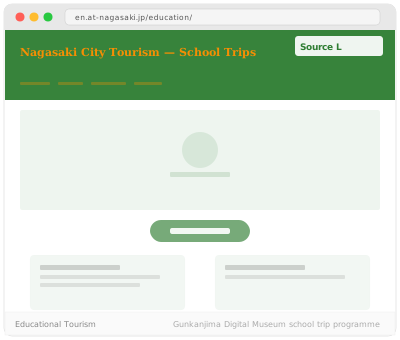
"Gunkanjima Digital Museum" — Nagasaki City tourism listing (school trip programme)
https://en.at-nagasaki.jp/education/article/industry/museum
The Gunkanjima Digital Museum is a commercial museum in central Nagasaki (admission: ¥1,800) that uses VR, projection mapping, and immersive digital technology to recreate Hashima "in its heyday." This particular page is from the Nagasaki City tourism site's school trip programme, which markets the museum as an educational experience for visiting Japanese school groups. The page describes how the museum allows visitors to "experience places that you cannot actually set foot in and the times when people lived there." It offers group discounts and recommends visiting the museum before taking the boat tour to the island to "increase your learning effect and satisfaction."
Guiding question: This museum recreates the experience of living on Hashima using digital technology. What period of the island's history does it recreate? What would a visitor learn about Hashima from this museum, and what would they not learn? Why does a museum's choice of time period matter when the site has a 90-year history?
Key content in English (this source is primarily in Japanese)
The museum uses VR, projection mapping, and immersive digital technology to recreate Hashima "in its heyday." The Nagasaki City tourism page markets it as an educational experience for visiting Japanese school groups, encouraging them to visit before taking the boat tour to "increase your learning effect and satisfaction." Admission is ¥1,800 (approximately £10). The museum recreates the period of community life on the island — not the wartime period.
Source M
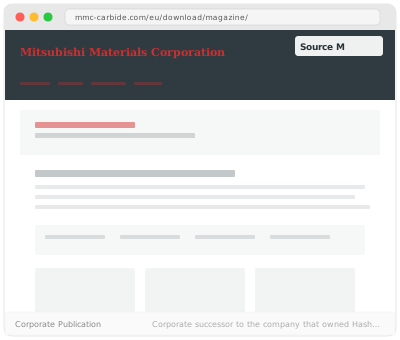
"Gunkanjima Island (Battleship Island)" — Mitsubishi Materials Corporation (MMC Magazine)
https://www.mmc-carbide.com/eu/download/magazine/vol07/16242
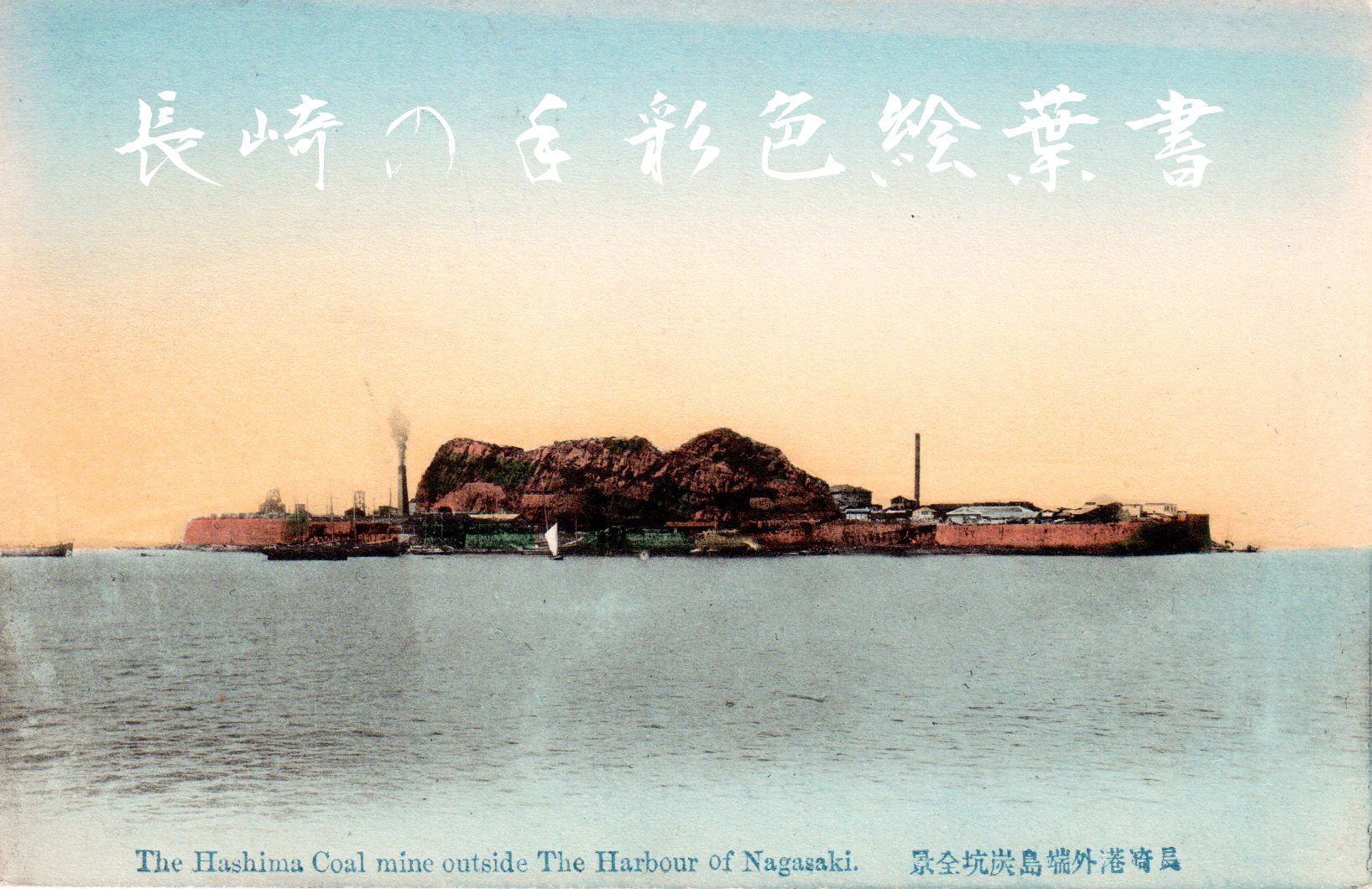
This article appears in the online magazine of Mitsubishi Materials Corporation, the corporate successor to Mitsubishi Mining Co., Ltd. — the company that purchased Hashima in 1890 and operated the coal mine for 84 years until its closure in 1974. The article describes four periods of production: expansion (1890–1914), the prewar period of "record high production" (1914–1945), the postwar period (1945–1964), and the final period leading to closure (1964–1974). It includes historical photographs of community life — a cinema, a swimming pool, children playing baseball — and describes how "living conditions were always being improved."
Guiding question: This source is written by the company that owned and operated Hashima. How does Mitsubishi describe the period 1914–1945? What does the phrase "record high production" tell us — and what does it leave out? Why might a corporation describe its own history in this way?
Key content in English (this source is in English)
The article describes four periods of production: expansion (1890–1914), "record high production" (1914–1945), postwar recovery (1945–1964), and decline to closure (1964–1974). It includes historical photographs of community life — a cinema, a swimming pool, children playing baseball — and states that "living conditions were always being improved." The period 1914–1945, which includes the wartime use of forced labour, is characterised solely by the phrase "record high production."
Source N
"Katō Kōko's Meiji Industrial Revolution: Forgetting Forced Labor to Celebrate Japan's World Heritage Sites" — Nikolai Johnsen, Asia-Pacific Journal: Japan Focus (2021)
https://apjjf.org/2021/23/johnsen (Part 1) and https://apjjf.org/2021/24/johnsen (Part 2)
This is a peer-reviewed academic article published in two parts in the Asia-Pacific Journal: Japan Focus, an open-access scholarly journal on Asia-Pacific affairs. The author, Nikolai Johnsen, examines the role of Katō Kōko — the same person named in Sources A and K — in shaping the heritage narratives around the Meiji Industrial Sites. The article argues that Katō "has created celebratory narratives of Japan that actively deny the history of its forced laborers" and that, "with the backing of powerful Japanese politicians," she "has put on a false performance of cooperation for UNESCO." It traces the connections between Katō's organisation (the NCIH), the official heritage websites, the Industrial Heritage Information Centre, and the "Truth of Gunkanjima" website (Source K).
This is the most challenging source on this sheet. It is long, detailed, and written for an academic audience. Teachers may wish to select specific sections rather than assigning the whole article.
Guiding question: This source connects Sources A, K, and F by identifying the same person and organisation behind all three. How does knowing this connection change the way you read those sources? What is the difference between reading a website on its own terms and understanding the institutional network behind it?
Teacher Notes
Suggested groupings for comparison
Group 1 — The tourism narrative (Sources B, C, D, I, L)
How is Hashima packaged for visitors and school groups? What story sells? What period of history does the tourism industry choose to recreate — and why?
Group 2 — The heritage narrative (Sources A, E, J)
How do official heritage institutions describe the site? What counts as "Outstanding Universal Value" and what falls outside it?
Group 3 — The contested narrative (Sources E, F, G, K)
What did Japan promise in 2015? What happened by 2020–21? How do the Japanese and Korean governments describe the same events? What does the "Truth of Gunkanjima" site reveal about how the heritage managers responded to criticism?
Group 4 — Who controls the story? (Sources A, K, M, N)
The official heritage site, the counter-narrative site, the corporate owner, and the academic analysis. Source N reveals that Sources A and K are managed by the same person and organisation. Start with A and K separately, then introduce N to show the connection.
Group 5 — The corporate inheritance (Sources M, A, I)
The company that profited from the mine, the heritage body that now celebrates it, and the tour operator that sells access to it. Follow the money: who benefits economically from Hashima today, and how does that shape what visitors learn?
Group 6 (Extension) — Digital source analysis masterclass (Sources A, G, K, H)
Give students Sources A, G, K, and H. Four sources, four radically different accounts of the same place. Ask: if you had never heard of Hashima before and encountered each of these sources separately, what would you believe? What happens when you read them together?
Key things to notice across all sources
What is NOT said. Source A describes Hashima's entire history without mentioning forced labour. Source M describes 1914–1945 as a period of "record high production" without mentioning who produced it. Sources B and C present the island without mentioning the UNESCO controversy. Source L recreates the island "in its heyday" without specifying whose heyday it was. Absences are as significant as presences.
Language choices. "Brought against their will and forced to work" (UNESCO 2015). "Requisitioned against their will" (Japanese Foreign Minister, immediately after). "Forced labourers" (Korean government). "Hard labor" (GaijinPot). "Misinformation" (NCIH, describing Korean claims). "Disinformation" (Korea.net, describing IHIC displays). "Record high production" (Mitsubishi Materials). The same historical events are described in language that carries different implications. Students should be encouraged to notice these differences and consider what work each phrase does.
Institutional connections. Source N is the key that unlocks the relationship between several other sources. The official heritage website (A), the "Truth of Gunkanjima" counter-narrative site (K), and the Industrial Heritage Information Centre criticised by UNESCO (F) are all managed by the same organisation, the NCIH, directed by the same individual. This is not a conspiracy — it is publicly documented. But it is invisible to a reader who encounters any single source in isolation. The ability to map institutional networks behind digital content is a critical skill for source analysis in the twenty-first century.
The digital landscape as a primary source. These are not neutral information resources. Each source was created by someone, for a purpose, within an institutional context. The tourism sites sell visits. The heritage sites justify inscription. The Korean government site challenges a diplomatic rival. The corporate history protects a brand. The NCIH site mobilises former residents to contest allegations. Wikipedia aggregates claims. The academic article traces the connections between them. The question is not "which one is right?" but "what is each source doing, and whose interests does it serve?"
Curriculum connections
AQA GCSE History — Britain: Migration, Empires and the People. The Hashima sources connect to the themes of industrialisation, the experience of empire (from the perspective of those subjected to imperial labour systems), and how attitudes to empire have changed. The source analysis skills transfer directly to the "How useful is Source X?" question type.
Edexcel KS3 — "Interpreting the British Empire: how has it been commemorated and contested?" Hashima provides a non-British case study of exactly this question. Students can compare how Japan's industrial heritage is commemorated and contested with examples from British heritage debates they already know.
Second-order concepts across all exam boards. The sources develop: significance (why does the UNESCO debate matter?), interpretation (why do sources disagree?), causation (what produced the gap between the 2015 promise and the 2020 reality?), and evidence (how do we evaluate competing claims when both sides cite evidence?).
Digital literacy and source analysis. These sources teach skills that apply far beyond this case study. Identifying who produced a website, understanding institutional relationships between sources, recognising what is absent from an account, and evaluating how language shapes interpretation — these are transferable skills for any digital source analysis task. The expanded source set (Sources K, L, M, N) particularly develops the ability to trace connections between apparently independent sources and understand how organisations construct narratives across multiple platforms.
Why Language Matters
Of the fourteen sources on this sheet, at least eight were originally produced in Japanese. The Korean government's response (Source G) was originally published in Korean. The UNESCO documents (Sources E, F, J) exist in English and French. Only a handful — the GaijinPot travel guide, the Wikipedia article, and the Mitsubishi corporate magazine — were written primarily for English-speaking audiences.
This matters because the debate about Hashima's history is not conducted in English. The people making the most consequential decisions — Japanese government officials, heritage managers at the NCIH, Korean diplomats, UNESCO committee members — are working in Japanese, Korean, and French. The English-language sources on this sheet are translations, summaries, or simplified versions of arguments that exist in much greater detail and nuance in their original languages.
When you analyse a source that has been translated, you are analysing two sets of choices: the original author's choices about what to say, and the translator's choices about how to say it in English. Sometimes the translation changes the meaning. Japan's UNESCO representative acknowledged in 2015 that Koreans were "forced to work" at the sites — but the Japanese government immediately clarified that this phrase did not mean "forced labour" (kyōsei rōdō). The distinction matters in Japanese; it was lost in the English-language coverage.
This is not a barrier that technology alone can solve. Browser translation tools can give you the general meaning of a Japanese webpage, but they cannot tell you whether a word carries political weight, whether a phrase echoes a specific legal argument, or whether the tone is formal, casual, defensive, or provocative. Understanding contested heritage requires understanding the languages in which the contest is conducted.
Learning East Asian languages
If working with these sources has made you curious about Japanese, Korean, or Chinese, you can study these languages at university — and you don't need any prior knowledge to start.
SOAS University of London is the UK's specialist university for the study of Asia, Africa, and the Middle East. It offers degree programmes in Japanese, Korean, and Chinese — including combined degrees with History, Politics, and other subjects. SOAS is where the Simulating Silence project was created.
Many other UK universities also offer East Asian language programmes. Search UCAS to find options closer to home. Some universities offer ab initio (beginner) language tracks within their degree programmes, so you can start learning Japanese or Korean from scratch as part of your degree.
For teachers: If your students are interested in East Asian languages, the Japan Foundation London and the Korean Cultural Centre UK both offer free or low-cost introductory language resources. The Japan Foundation's annual Japanese Speech Contest is open to secondary school students.
Download
Download the source sheet as a PDF for printing or sharing with colleagues.
Download Source Sheet (PDF)
KS3 Source Pack: Sources B, C, D, I, L (PDF)
GCSE Source Pack: Sources A, E, F, G, K, N (PDF)
Last updated: March 2026
Secondary Teacher HubSource sheet prepared for use with Simulating Silence is a Learning Resource from the Hashima XR Project (simulating-silence.org). All URLs verified February 2026.