Teaching Hashima in Your Classroom
A guidance document for secondary history teachers
You do not need to be a Japan specialist to teach this material effectively. This guide provides the background knowledge, classroom strategies, and curriculum connections you need to use Hashima Island as a case study in contested heritage with your KS3 or GCSE history students.
Time to read: 8–10 minutes. This document is also available as a downloadable PDF for printing or sharing with colleagues.
1. What Is the Hashima Case About?
Hashima Island (also called Gunkanjima, meaning "Battleship Island") is a small island off the coast of Nagasaki, Japan. For nearly a century it was a coal mine and company town operated by Mitsubishi. At its peak in 1959, over 5,000 people lived on just 6.3 hectares of concrete — the highest population density ever recorded anywhere on Earth. The mine operated from 1890 to 1974. Mitsubishi owned every building on the island: the apartments, the school, the hospital, the shops, even the cinema. Workers and their families depended entirely on the company.
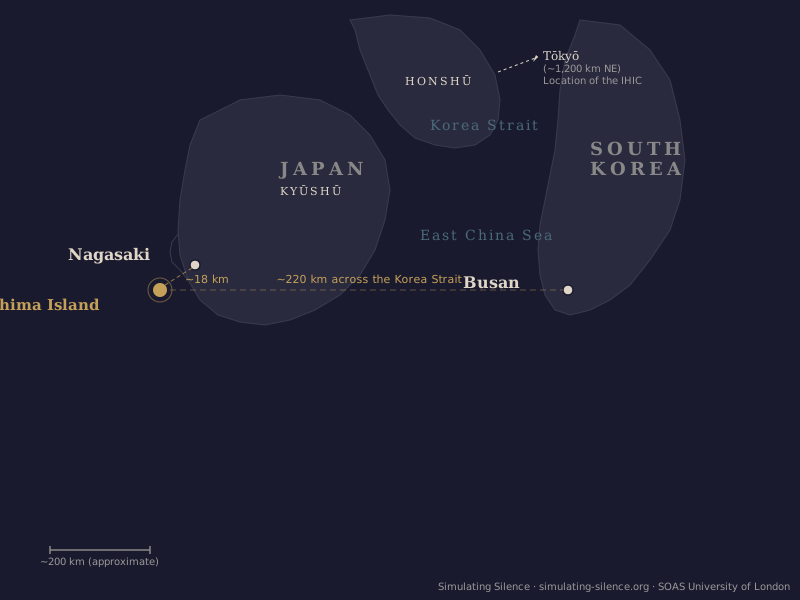
During the Second World War, the Japanese government passed laws directing workers to strategic industries. Between 1939 and 1945, Korean and Chinese workers were brought to Hashima under coercive conditions to mine coal for Japan's war effort. They were forced labourers — people made to work against their will. Conditions underground were dangerous, and some workers died. After the war ended in 1945, the surviving forced labourers left. How many worked there, and exactly what happened to them, remains debated — partly because the evidence itself has become politically contested.
In 2015, the island was inscribed as a UNESCO World Heritage Site as part of Japan's Meiji Industrial Revolution. At the time of inscription, Japan's representative at UNESCO acknowledged that workers had been "brought against their will and forced to work under harsh conditions," and Japan committed to telling the "full history" of the site, including the experience of forced labourers. By 2021, UNESCO's World Heritage Committee concluded that Japan had not fulfilled this commitment. The Committee expressed "strong regret" — in diplomatic language, a serious criticism — that the official interpretation centre in Tokyo did not properly acknowledge the forced labour history.
For your classroom, the case is best understood as a study in how industrial heritage gets commemorated and who gets left out of the story. This is a pattern your students will recognise. The debates about statues, memorials, and museum interpretation happening in the UK today — from the Colston statue in Bristol to the reinterpretation of country house histories — involve exactly the same dynamics. Who decides what a historical site means? What happens when official narratives leave out the experiences of people who were harmed? How do institutions manage difficult histories without appearing to censor them? Hashima makes these questions visible through real, documented sources that students can analyse directly.
2. How It Connects to Topics Students Already Know
You already teach the analytical skills this material requires. The Hashima case does not ask you to become an expert in Japanese history. It asks you to apply a comparative framework you already possess — one built from teaching about empire, industrialisation, and contested commemoration in British and European contexts — to a non-British case study.
Forced labour is not unique to Japan's wartime empire. British students studying the Atlantic slave trade, indentured labour in the British Empire, or the use of convict labour in colonial Australia are already developing frameworks for understanding how imperial powers extracted labour under coercive conditions. The Hashima case adds a parallel from a different imperial context. The specific mechanisms differed — Japanese wartime labour mobilisation operated through different legal instruments than British colonial labour systems — but the underlying pattern of imperial states directing subject populations into dangerous industrial work for the benefit of the metropole is one your students can recognise and analyse.
The curriculum connections are specific and examinable. For AQA GCSE "Britain: Migration, Empires and the People" (Paper 2A/C), the Hashima case connects directly to industrialisation, the experience of empire, and attitudes to empire — viewed from the perspective of those subjected to imperial labour systems rather than those who administered them. For Edexcel KS3 "Interpreting the British Empire: how has it been commemorated and contested?", Hashima provides a non-British parallel case that allows students to practise analysing contested heritage interpretation without the personal proximity that sometimes makes British Empire topics emotionally charged for students with direct family connections to colonial histories. The analytical skills transfer directly: the second-order concepts that all exam boards assess — significance, interpretation, causation, evidence — are exactly the skills students develop through working with the Hashima sources.
Using a Japanese case study has a specific pedagogical advantage. It gives students analytical distance. They can practise evaluating competing institutional narratives, identifying what sources include and exclude, and understanding how heritage is governed — all without navigating the personal and family connections that can make British Empire topics emotionally fraught for some students. Once they have developed these skills using Hashima, they can apply them with greater confidence to British cases where the stakes feel closer to home.
3. Classroom Management Advice
Setting up discussion norms. Before engaging with material about coerced labour, establish clearly that the lesson is about analysing institutional behaviour, not judging a national culture. Students should understand the difference between critiquing a government's heritage policy and making claims about a people. This distinction mirrors how they might discuss British colonial history — critiquing imperial policy is not the same as condemning everyone who lived in Britain at the time. Frame the analysis around institutions, decisions, and documented evidence. When students make claims, ask them to point to specific sources. This keeps discussion grounded in evidence rather than generalisation.
Handling the Japan–Korea political dimension. The material involves a live diplomatic dispute between Japan and South Korea. Students do not need to take sides. Frame it clearly: two governments disagree about how a historical site should be interpreted. The question for historians is not "who is right?" but "what does each side's position reveal, and what evidence supports or undermines their claims?" This is the same analytical framework students use for any contested interpretation. If students ask "but who is actually right?", redirect them: "What would you need to see to decide? What evidence would change your mind?" These are the questions that build historical thinking, not premature conclusions.
Working with difficult content. The forced labour content is serious but not graphic in the way that some Holocaust or slavery materials can be. The primary challenge is conceptual, not emotional: understanding how institutions can suppress historical evidence through procedural means rather than overt censorship. There are no distressing images in the source sheet. The difficulty lies in understanding how official narratives can acknowledge something in words while effectively minimising it in practice — a subtle concept that rewards careful reading rather than emotional processing. Frame the lesson around institutional analysis rather than individual suffering. The question is not "how terrible was this?" but "how do institutions manage contested histories, and what does that management look like in the documents?"
Language sensitivity. The sources use different terms for the same events: "forced labour," "requisitioned labour," "workers brought against their will," and — from one Japanese government source — the claim that "forced to work" does not mean "forced labour." These differences are not a source of confusion. They are part of what students are analysing. Make this explicit at the start of the lesson. Tell students: "You are going to notice that different sources use different words for the same events. That is not an accident. Noticing those differences, and asking why they exist, is the skill we are practising today." When students understand that language choices are evidence, not obstacles, the analytical work becomes much clearer.
4. What This Resource Does and Doesn't Cover
This resource was created by a historian at SOAS University of London who worked on the HashimaXR virtual reality project — a project that was itself subject to the institutional constraints it describes. The resource does not claim neutrality. It models the kind of positional transparency it asks students to develop. When we ask students to consider who created a source, who it was for, and what institutional context shaped it, we apply the same questions to this resource. The author's involvement in the HashimaXR project is disclosed, not hidden, because transparency about positionality is a skill this material teaches.
The resource does not provide a comprehensive history of Japanese colonial labour policy. It does not settle the historiographical disputes it describes. It does not cover the full range of scholarly debate about wartime labour mobilisation in Japan's empire. What it provides is a framework for thinking about how contested histories are governed — and documented evidence, drawn from publicly accessible digital sources, that makes those dynamics visible to students working at KS3 and GCSE level.
The source sheet (14 digital sources, A–N) forms the foundation of all classroom activities. Teachers should review the full source sheet and the teacher notes before using the lesson plans. The sources are real, publicly accessible websites and documents. Students are working with the same materials a university researcher would use — adapted for accessibility, but not simplified in their analytical demands.
Download
Download this guidance as a PDF for printing or sharing with your department.
Download Teacher Guidance PDFLast updated: March 2026
Secondary Teacher Hub